20 Journal Prompts for Returning to Something You Stopped
Most of us have something we stopped: a practice, a habit, a project, a routine or a plan. The reasons are usually ordinary. Work changed, health changed, other people needed us, or energy ran low.
It is easy to treat the gap as a verdict on you. It is more useful to treat it as information about what changed, what still matters and what a version that fits your life now could look like.
Returning is only one answer
When you look at something you stopped, there are several honest outcomes. You might return to it as it was, return to a smaller version, change its shape, pause it again or let it end. None of these is a failure, and nobody else needs to know which you choose.
Questions that allow for all of these tend to work better than a plan that assumes you will resume. They also work better than a streak, which punishes the very interruptions that real weeks contain.
20 journal prompts for returning to something you stopped
These twenty are taken word for word from the optional questions printed in Small Ways I Begin Again. The journal has one on each of its 30 entries, across five parts, and these are chosen from all five. Each one refers to something you stopped, so keep one practice, habit or project in mind. Pick one prompt and write for five minutes, or write one line. “Not sure”, “nothing yet” and “I would rather not” are all complete answers. Take another prompt on another day.
- When did it stop, as far as you can tell, and what was going on around that time?
- What changed around you, if anything?
- What did you expect of yourself in connection with this?
- What did this give you, even in small ways, such as enjoyment, calm, pride or a sense of yourself? Does any of it still matter to you?
- If you wanted to do a very small version of this today, what would it be?
- What could you remove from the original version, such as a standard, a step, a target or a tool?
- Would a different time or place suit this better than before?
- What might a first step look like if it were only that, a step, and not the start of a count?
- If you have made one attempt recently, what was it?
- What did the attempt show you, if anything, about timing, effort or what you want?
- Would a small change to your surroundings or tools make this easier, such as where something is kept or what is within reach?
- Consistency can mean doing something at set times, or it can mean coming back when you can. What definition would fit your life?
- Is there a plan that no longer fits your circumstances?
- Is there an interruption you can expect, such as a busy season, a family commitment or a flare of symptoms?
- If you stop again, what might help you return, if you want to?
- Is there something you have decided, or are considering deciding, to let end?
- What might tell you that you are asking too much of yourself, such as dread, avoidance or exhaustion?
- What could count as enough in this area of your life at present?
- Is there anything from these pages, or from what you began again, that you want to continue?
- Is there anything you want to leave on these pages and not carry forward, such as an expectation, a plan or a worry?
The four questions behind every entry
Alongside the optional question, every entry in the journal asks the same four short questions about whatever you have in mind. They are a useful frame even without the journal:
- What interrupted me?
- Does this still matter to me?
- What could become smaller or different?
- Is there a next step I want to choose?
In the journal, “No” or “not sure” is a valid answer to the second question, and pausing or stopping may be the answer to the fourth.
A small exercise for today
Choose one thing you stopped. Answer the four questions above in a single line each, using the plainest words you have. Then stop. You do not need to decide anything today.
If one line is too much, write one word. If none of the questions fits, that is information too.
This is the idea behind Small Ways I Begin Again: 30 undated entries in five parts, from understanding the interruption to keeping a way back, with reviews and optional pauses. It is a reflection tool, not a promise of results, and the pace is yours.
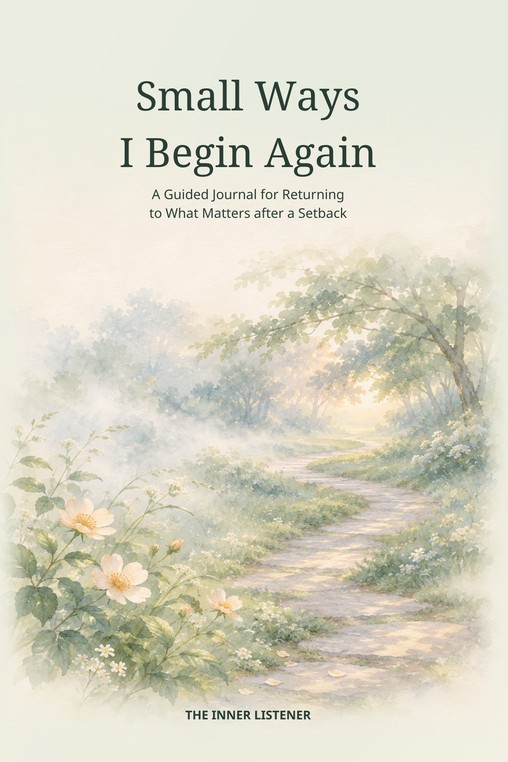
Small Ways I Begin Again
A guided journal for returning to what matters: four short questions, no streaks, and the freedom to change direction, pause or let something end.
More like this
Not sure which journal? Take the two-minute quiz →
How to Begin Again When You Have Stopped Something That Matters →
More prompt sets in the Choices room
- The Life I Keep Postponing — prompts from The Life I Keep Postponing
- The Direction I Am Choosing — prompts from The Direction I Am Choosing
- What Deserves My Yes — prompts from What Deserves My Yes
- The Ideas I Keep Quiet — prompts from The Ideas I Keep Quiet
- Make a little Room — prompts from Make a little Room
Get new prompts and posts by email
No schedule, no spam — just an email whenever a new post goes up.