How to See Your Progress When It Feels as Though Nothing Has Changed
The free preview is available now on the journal page. The Amazon links will appear there as soon as the journal is live.
A task that used to take an afternoon now takes twenty minutes. You finish it, notice the next unfinished thing and move on.
Asked whether you have made progress lately, you might say you are not sure.
It is easy to lose sight of an older difficulty once it has become familiar. The present version of a task can start to feel like the way it always was. To see the change, it helps to put two descriptions beside each other.
Begin with something you can compare
Choose an ordinary situation: sending an email, asking a question, preparing a meal, making a decision or admitting you need help.
Write how it used to be. Then write how it is today. Be specific about the effort, time, support or preparation involved.
An illustrative comparison might look like this:
An illustration written for this article
I spent most of Sunday dreading Monday’s team meeting and wrote out every sentence I might need.
I still make notes, but I choose two things I want to say and leave the rest open.
I asked a question in today’s meeting that I had not rehearsed.
There can still be nerves in the Now column. The difference is worth recording as it actually is.
A journal for that comparison
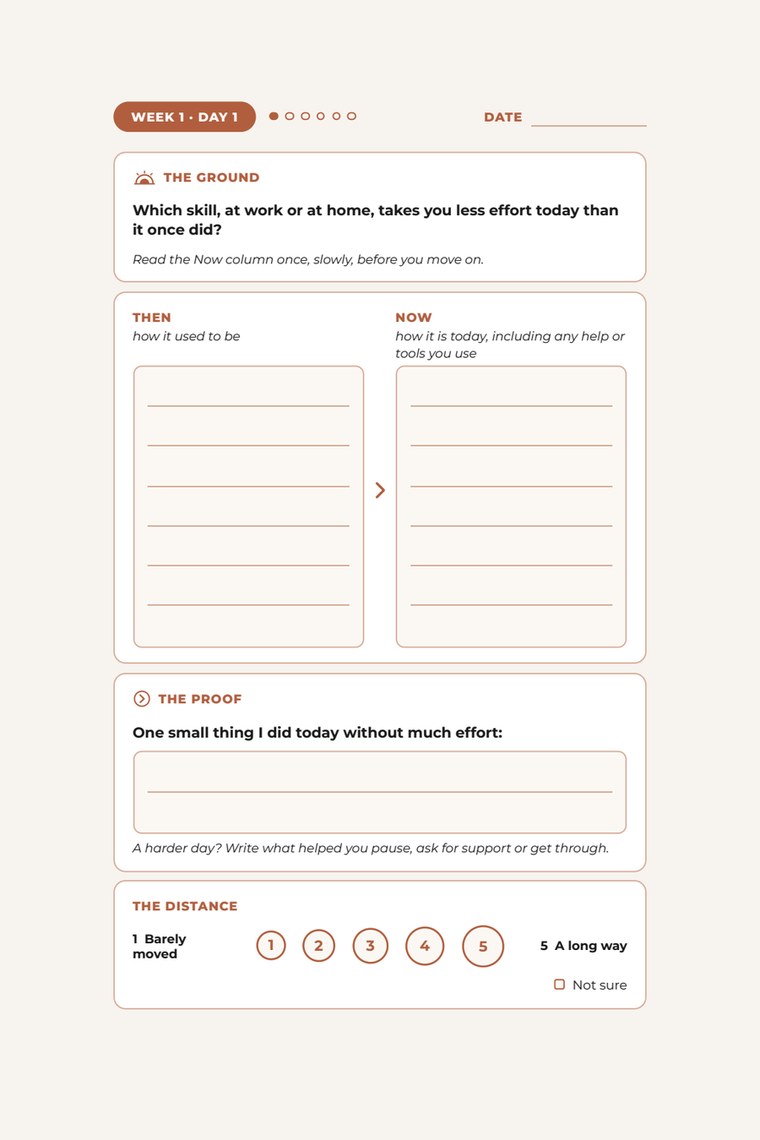
The Ground I Have Already Covered is an eight-week guided journal for seeing how far you have already come. A daily page asks for Then and Now, The Proof, and The Distance.
The proof is one specific example. The distance is a personal reflection from 1 to 5, with a “not sure” option. It gives you a way to mark how the comparison feels today.
The Now column explicitly includes any help or tools you use. Getting support can be part of the change you are recording. You do not need to edit it out to make an entry count.
Across the eight weeks, the prompts explore a skill, a fear, a habit, a conversation, your body, an old reaction and something you no longer avoid, before bringing the whole distance together. Each week contains six daily entries and a review.
What about a harder day?
An honest comparison may show that something is unchanged or more difficult. The journal allows that. The distance can go down as well as up, and the daily page offers space to record what helped you pause, ask for support or get through.
If the past is difficult to remember, the opening guidance suggests routes back, such as an old message or your first attempt at something. You can also compare with a more recent time or leave the Then column open.
The point is to keep an accurate record you recognise when you read it.
The page to open when you cannot see it
Towards the back, the Proof File gathers one nomination from each week. You can circle five you most want to keep in view.
On a day when “I have got nowhere” feels convincing, you have specific entries to consult: what happened, what it used to cost you and what is different now. The words remain your own.
Is this your starting point?
Choose Ground if you want a structured way to look backwards and recognise change already made. It suits a reader who finds concrete examples easier to work with than general encouragement.
If you want to spend your writing time imagining something good ahead, The Thing I Am Looking Forward To has that focus. If you want to keep a passing pleasure from today, The Delight I Almost Missed starts with the moment itself.
Look inside The Ground I Have Already Covered or read the free preview. Try one Then-and-Now comparison before deciding whether you want a whole journal for it.
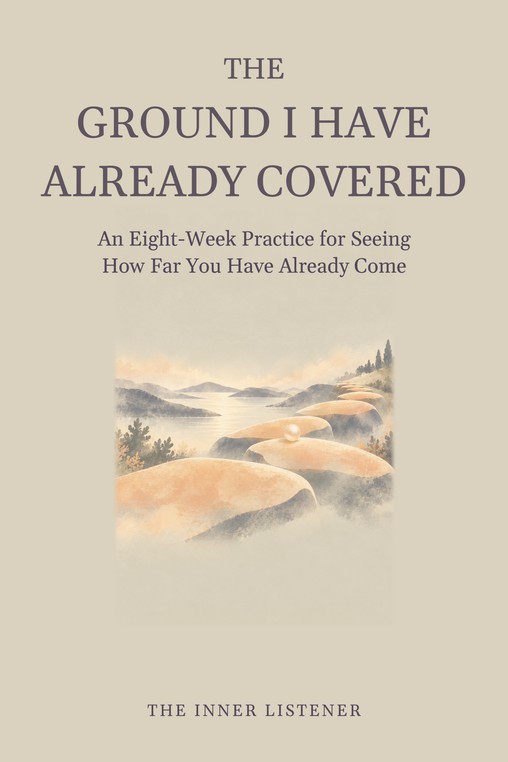
The Ground I Have Already Covered
An eight-week guided journal for seeing how far you have already come.
More like this
A Small Thing to Look Forward To Is Still Something →
Get new posts by email
No schedule, no spam — just an email whenever a new post goes up.