Shadow Work Journal Prompts for the Parts You Usually Keep Quiet
The Parts of Me I Do Not Introduce is available on Amazon in paperback and hardcover. It is written for readers who already know what shadow work is. See the journal page for the buy links and a free preview.
Someone makes a passing comment. The conversation moves on, but you keep returning to the words.
You remember what they said, the answer you gave and the answer you thought of afterwards. You may be clear about what bothered you. You may have several possibilities.
A page can give those possibilities somewhere to sit. Begin with a moment you feel able to consider and a question you can leave unfinished.
What does shadow work mean?
The idea of the “shadow” comes from Carl Jung and concerns aspects of ourselves we tend to keep outside our usual picture of who we are. Those aspects can include qualities we find uncomfortable, as well as confidence, assertiveness or other qualities we have learnt to hide. Cleveland Clinic describes shadow work as a form of self-exploration and notes that research into it remains limited. Read its clinical overview.
In a journal, you might explore a reaction, a role you often take or a personal rule you rarely question. You can treat what you write as a possibility to consider and return to.
Choose a moment you can comfortably describe
Pick an ordinary, manageable situation. Perhaps someone misunderstood a message, interrupted you or declined a request.
Start with the details you remember. What happened? What did you hear? What did you feel or do afterwards?
Keep the account short enough that you can read it back. Leave out names or details you want to keep private.
If you are already very upset, you can leave the exercise for another time.
Give your reaction more than one explanation
Imagine a colleague says, “You always have everything under control.”
You smile, then feel irritated for the rest of the afternoon.
One possibility is that you wanted someone to notice how much effort the work took. Another is that you felt pressure to keep being the capable person. You may also have heard the comment differently because you were tired or because earlier conversations gave it a particular meaning.
These are possible readings of an illustrative situation. The person writing about it would need to decide which, if any, fit.
You can ask about the present situation, your expectations, the other person’s behaviour and the context around you. Several explanations may sit alongside one another.
Five prompts for a little more room
These prompts were written for this article.
- What happened, in the plainest words I can find?
- What did I take the moment to mean?
- Which feeling or expectation seems worth naming?
- What else might explain my reaction?
- Is there anything I want to say, ask, change or leave alone?
A useful answer may be specific and ordinary.
“I wanted them to ask whether I needed help.”
You can stop there. You can return another day and see whether the sentence still fits.
Look at a familiar role
Some questions concern the version of yourself you often bring into a room.
You might be the reliable one, the easygoing one, the person who makes everyone laugh or the person who rarely asks for help.
Think about where that role feels comfortable and where it takes effort. What do you enjoy about it? When do you want more choice?
You can also look at a rule you carry, such as “I should always be useful” or “I should keep the peace”. Ask where it appears in your life now and whether it still fits the situation in front of you.
You can keep the reflection in the present. Exploring where a rule came from is optional.
Inside The Parts of Me I Do Not Introduce
The Parts of Me I Do Not Introduce is a 108-page shadow work journal for readers who already understand the idea and have done some reading of their own.
Thirty guided entries across six parts explore what sets you off, admiration and envy, the roles you play, inherited rules, the parts you push away and meeting those parts with curiosity.
Each entry offers three questions, writing space and an optional experiment. Mirror pages, pauses, a reflection log, a parts map and a closing letter provide different ways to look back.
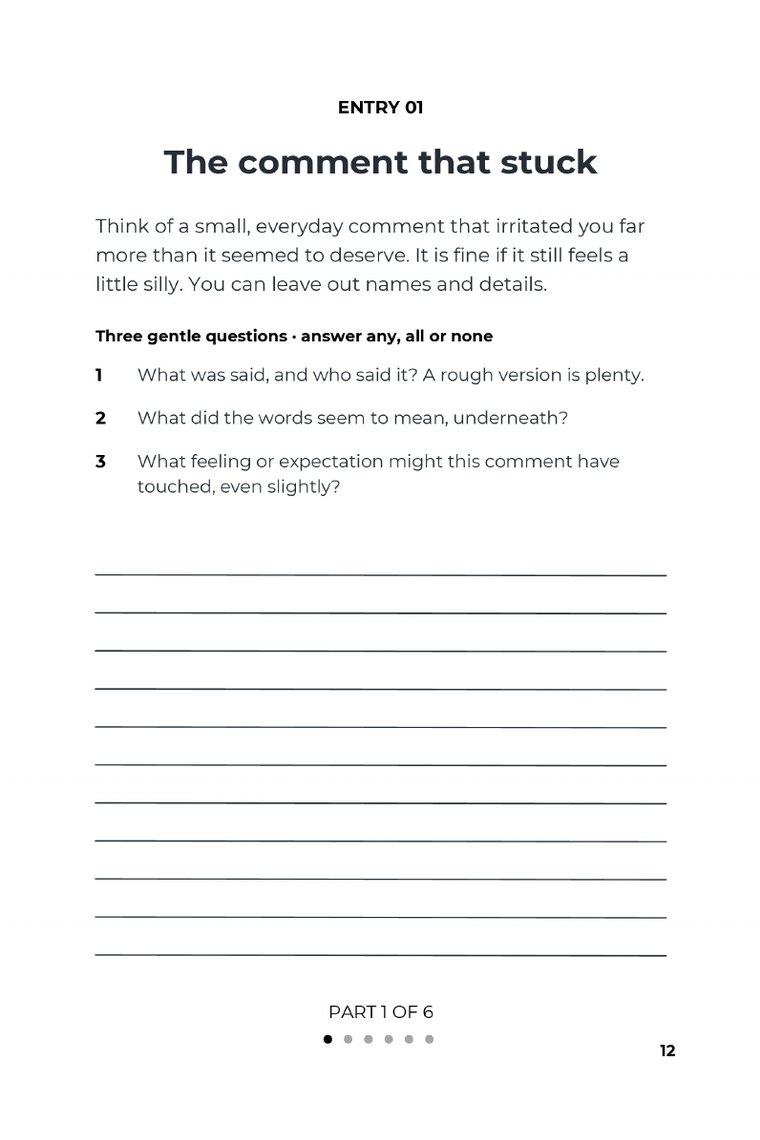
The journal includes an entry called “The comment that stuck”. Its questions invite you to consider what was said, what the words seemed to mean underneath, and what feeling or expectation the comment may have touched.
You can answer one question, skip an entry or close the book.
Choose your pace and support
Writing about hidden or uncomfortable feelings can bring up distress. If that happens, pause and consider speaking with a qualified mental health professional. Cleveland Clinic recommends professional guidance when shadow work involves trauma or intense emotions. Read its guidance on starting.
This article and the journal offer personal reflection. For treatment or help with distress, seek care from a qualified professional.
The shorter companion, The Part of Me I Almost Met — 14 Day Printable Planner, is an 18-page PDF with fourteen daily prompts, a pause and look-back after day seven, and a closing reflection.
Its focus is one quiet part of yourself and the small moments in which you notice it.
Explore The Parts of Me I Do Not Introduce, with buy links for Amazon in your country, or go straight to the paperback on Amazon.com.
See The Part of Me I Almost Met printable planner on Gumroad.
For today, you might leave yourself one question.
What part of this reaction would I like to understand a little better?
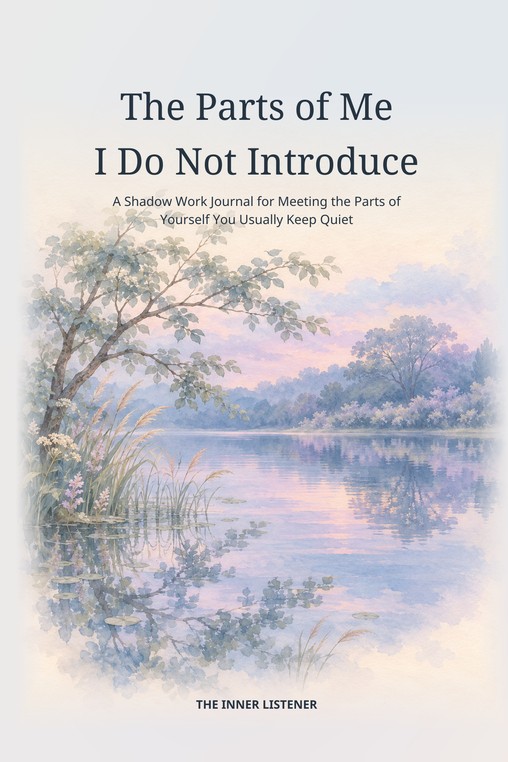
The Parts of Me I Do Not Introduce
A shadow work journal for meeting the parts of yourself you usually keep quiet, written for readers who already know what shadow work is.
Get new posts by email
No schedule, no spam — just an email whenever a new post goes up.