How to Keep the Funny, Unexpected Stories From Your Life
The Stories I Want to Remember is available on Amazon in paperback and hardcover. See the journal page for the free preview and buy links.
There is a story you tell at dinner every few years. The cupboard job that became an afternoon. The word you misheard for a decade. The time you were completely certain, and completely wrong.
You tell it with the same detail every time, and it always gets the same laugh. And yet you have never written it down.
Small stories like these are the ones that vanish first. They feel too minor to record. Nobody asks for them, and they do not seem to mean anything. Then one day the person who was there with you is no longer around to correct your version, and you realise how much of a life lives in them.
What counts as a story worth keeping
Almost anything with a scene in it counts. Look for the moments where a plan took a turn, an object behaved in an unexpected way or a perfectly ordinary day produced one odd detail.
A few places to look:
• A five-minute job that became a different sort of job.
• A time you were confidently wrong.
• A peculiar little habit that only your household understands.
• A small adventure that began with “we will just pop out”.
• Something you cooked, found, kept or lost.
None of these needs a moral. They only need to be yours.
Begin with one detail
You do not have to remember the whole thing. Pick one detail and write that down first: where you were, what you said, what the object looked like, the exact words that gave the game away.
A detail is often the part that makes the story feel like yours. Once it is on the page, the rest tends to follow, or at least enough of it does.
A small example, written for this article. This is an illustration, not a real entry.
“I went up to the loft for a box of Christmas decorations. Forty minutes later I was sitting on the floor in a cardboard fort, reading my old school reports out loud to nobody.”
That is three lines. It has a setting, a turn and a ridiculous image. It is a story.
Keep it light
It helps to treat the page as somewhere to be light rather than profound. You are not writing a memoir. You are keeping the things that would otherwise slip away, in your own words, with the awkward bits left in.
If you cannot remember how it ended, say so. If your family tells it differently, write both versions. If it only makes sense to the two of you, that is exactly why it is worth keeping.
Inside The Stories I Want to Remember
The Stories I Want to Remember is a 112-page guided journal with 42 story invitations across six chapters, with two pages for each story: one to begin it, and a facing page with an optional detail question and extra space.
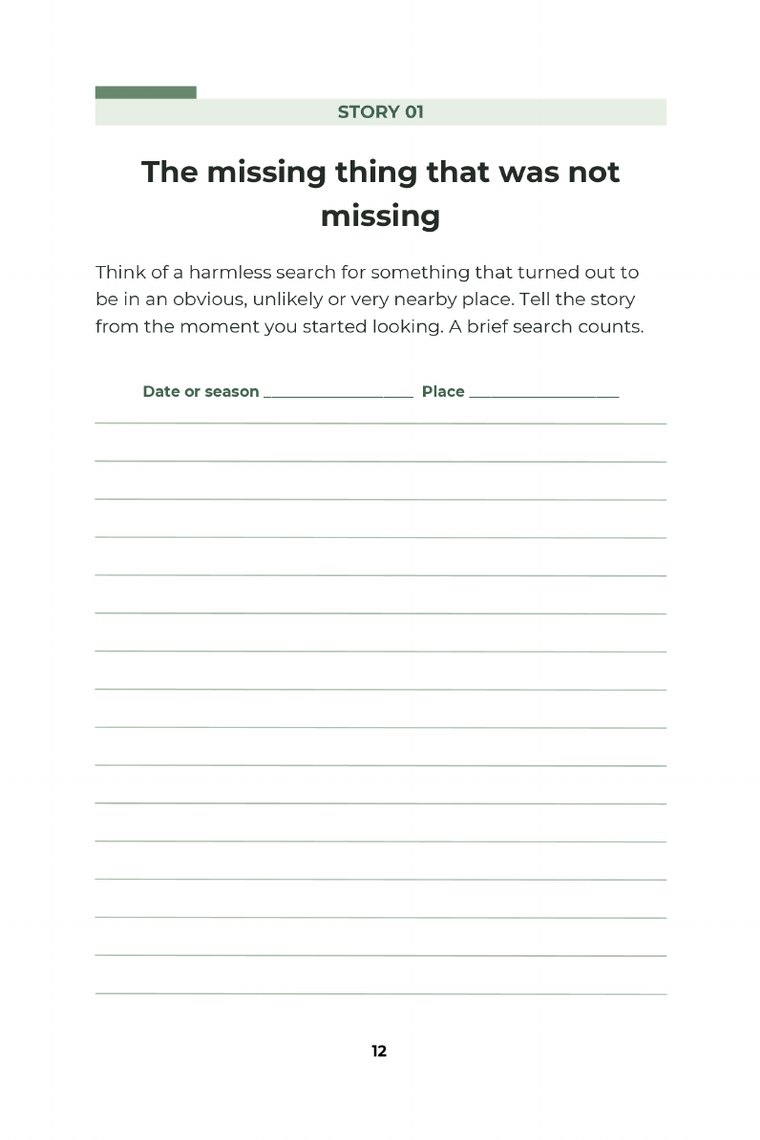
It also has memory sparks for when nothing comes to mind, pages for sketches and a story index at the back so you can find a favourite again. The invitations can be used in any order, with no schedule to keep. A suggested pace is a chapter a week, but you can take longer or write several at once.
See the journal, read the free preview, or go straight to the paperback on Amazon.com.
If a story has come to mind while you were reading, begin it now:
What was the first place you looked, and where was it all along?
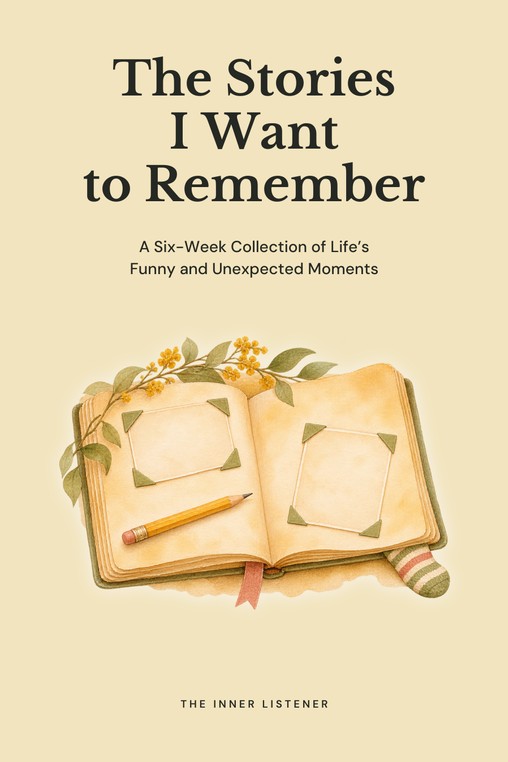
The Stories I Want to Remember
A six-week collection of 42 story invitations for keeping life’s funny, unexpected and ordinary moments in your own words.
More like this
How to Write a Short Story From Your Own Life Without a Punchline →
20 Journal Prompts for Keeping the Funny, Unexpected Stories of Your Life →
Get new posts by email
No schedule, no spam — just an email whenever a new post goes up.