20 Journal Prompts for Catching a Reaction Before It Happens
The sharp reply. The shutdown. The spiral. Most reactions are over before there has been time to decide anything, and you only notice afterwards, when the moment has passed and the words are already out.
That is not a failure of willpower. Reactions are fast by design, and they run on habit. The useful question is not how to stop reacting, but how to notice the moment just before, even for a second.
Why reactions are faster than thought
A trigger, an emotion and a response can feel like one event. Pulled apart, they are three: something happened, something was felt, and something was done. The gap between them is small, but it is where a different choice can sit.
Writing builds the habit of seeing the three separately. You do not need to catch every moment. Noticing one a week, and writing it down plainly, is a real start.
20 journal prompts for catching a reaction before it happens
Choose one prompt and write for five minutes. Describe what happened as plainly as a camera would, without judging yourself. Skip any prompt that does not fit your week.
- What is the very first sign, in my body, that I am about to react?
- What did I feel in the second before I spoke or acted?
- What was the trigger, described as plainly as a camera would record it?
- What emotion came first, and what came underneath it?
- What did I do in the next few seconds?
- If I could freeze that moment for three seconds, what would I notice?
- What is my usual first move: snap, shut down, spiral or smooth it over?
- What pause could I realistically use in that exact situation?
- Where do my reactions happen fastest: at home, at work or online?
- At what time of day am I most likely to react, and why might that be?
- What did the reaction get me, and what did it cost?
- What would I like to have said or done instead?
- What small physical cue could remind me to pause: my breath, my hands, my jaw?
- How would I write the trigger, the emotion and the response as three separate lines?
- Which trigger showed up more than once this week?
- When did I catch myself in the moment this week, even partly?
- What helped me catch it?
- What did I do in the moment I caught it?
- What does the shape of this week tell me about what runs me?
- Which trigger would I like to meet differently next week?
A small exercise for today
Think of one reaction from the last day or two. Write it as three separate lines: what triggered it, the emotion it produced, and what you felt or did next. Keep each line to one sentence. That is the whole exercise, and it is meant to be small.
Writing is a reflection tool, not a substitute for support. If a reaction feels overwhelming or unsafe, please talk to someone you trust or a professional.
This is the idea behind The Pattern Interrupt: 30 days of tracking the trigger, the emotion and what followed, with a weekly review and a look at the whole month. It is a reflection tool, not a promise of results, and the pace is yours.
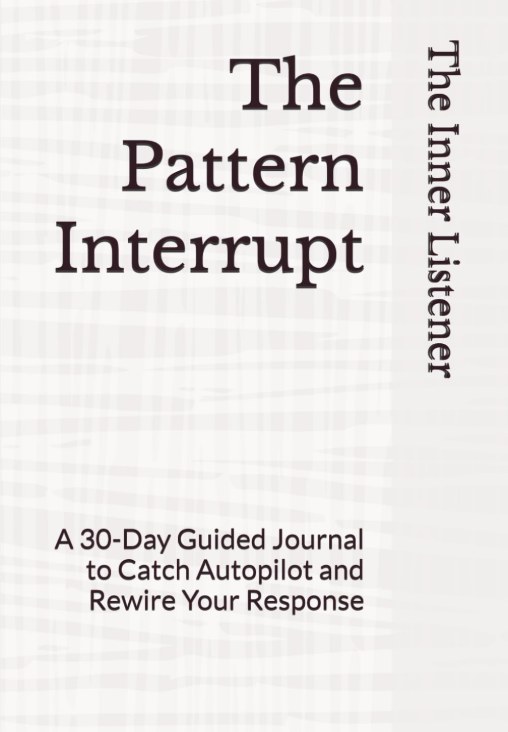
The Pattern Interrupt
A 30-day guided journal for slowing down the moment before autopilot takes it, so you can see the trigger, the emotion and the response as three separate things.
Get new prompts and posts by email
No schedule, no spam — just an email whenever a new post goes up.